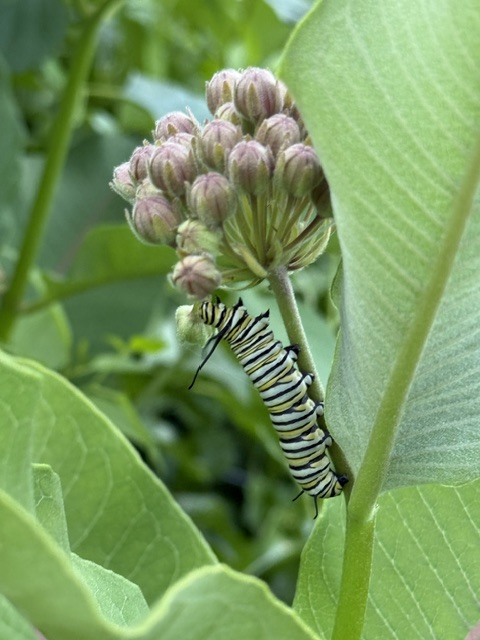
Our friend in town has a mesh enclosure in her kitchen with several monarch caterpillars and fresh milkweed. She had collected tiny eggs from her garden and was raising them inside, where she can watch their incredible transformation while keeping them safe from hungry predators. I was lucky enough to watch her video of one caterpillar in that mind-boggling moment when it hangs upside down by its back end, splits out of its striped skin, and transforms into a gorgeous jade-green chrysalis. It looks so simple and quick for something that packs in such huge biological drama in just a few minutes.
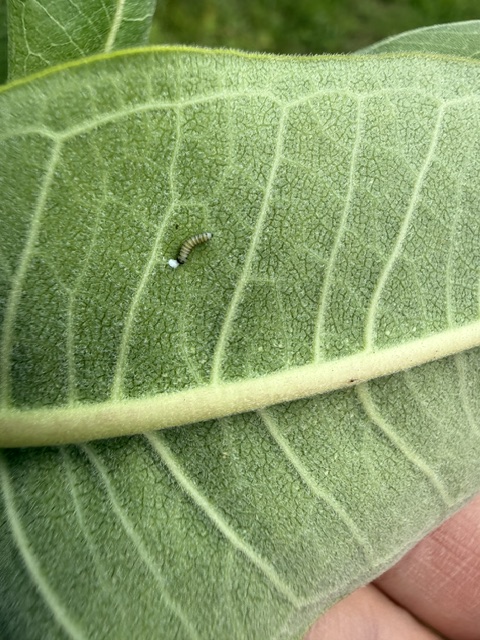
Thus inspired, I went looking for monarchs in the wild on our Land Trust properties. Walking down along the edge of the Simpson Preserve, I started checking every common milkweed plant I could find. Sure enough, I found both eggs and caterpillars: tiny ones not much bigger than the tip of a pencil, and larger “teenagers” clearly further along in their growth. Seeing that tiny caterpillar made me think about a big monarch caterpillar I saw back in June, and about how many different generations of monarchs must pass through Connecticut each year.
Science tells us that most summer monarchs live only 2 to 5 weeks, and there are several generations each season, each one moving a little farther north as milkweed and nectar plants appear. The butterflies we see laying eggs here in early summer are the children or grandchildren of monarchs that overwintered by the millions in a few forested mountain sites in Mexico. Their offspring grow up on our local milkweed, lay more eggs, and then those caterpillars become the late-summer monarchs, or the so-called “super generation.” This final generation does not rush to reproduce. Instead, their bodies switch into migration mode, and they can live 6 to 9 months as they build up fat on nectar in our fields and gardens before flying all the way back to Mexico to spend the winter there. So that tiny caterpillar I saw might be the child, or even grandchild, of monarchs that overwintered in Mexico, and its own offspring could become part of the late-summer generation that leaves Bethany and heads thousands of miles south.
And what happens inside that chrysalis is equal parts bizarre and fascinating! That same friend recommended I listen to a Radiolab episode called “Goo and You,” which explores what really happens when a caterpillar turns into a butterfly. Much of the body is broken down into a kind of living “soup,” yet some structures and even memories amazingly seem to persist through the transformation. In one experiment they describe, caterpillars were trained to dislike a particular smell, and after metamorphosis the adult moths still avoided that smell, suggesting that at least some memories can survive the trip through the goo. It is wild to think that a monarch caterpillar munching milkweed along the Simpson Preserve might someday “remember” which plants tasted good, or which spots were safe, even after it has hung upside down, shed its skin, and emerged as a butterfly. I like to imagine, half seriously, that a butterfly gathering nectar in a Bethany field might even recall my curious human face peering down at it back when it was just a tiny stripy caterpillar.
Monarch caterpillars are rather picky eaters: they eat only milkweed, and adult monarchs lay their eggs on milkweed so their caterpillars will have food as soon as they hatch. In Connecticut, common milkweed, swamp milkweed, and butterfly weed are wonderful native choices to plant. Adult monarchs seek out a different kind of buffet comprised of nectar from flowers. Native plants such as Joe-Pye weed, goldenrods, asters, wild bergamot, and New York ironweed can provide important fuel for the adults, especially in late summer and early fall, when the migratory generation is fueling up for its journey south.
Seeing monarch eggs and caterpillars on our Land Trust trails reminds me that we play a small but critical role in this big migration story! The generations that end up in those distant Mexican wintering sites start as eggs on milkweed leaves in places like the Simpson Preserve and other Bethany spots that host milkweeds. By protecting these properties and by planting and preserving native milkweeds and nectar plants in our own yards, we give each little caterpillar a chance not just to become a butterfly, but to join one of the most extraordinary migrations on Earth.
Stay cool and hydrated out there. Happy hiking!
~Ali Beres-Nork
Sources: